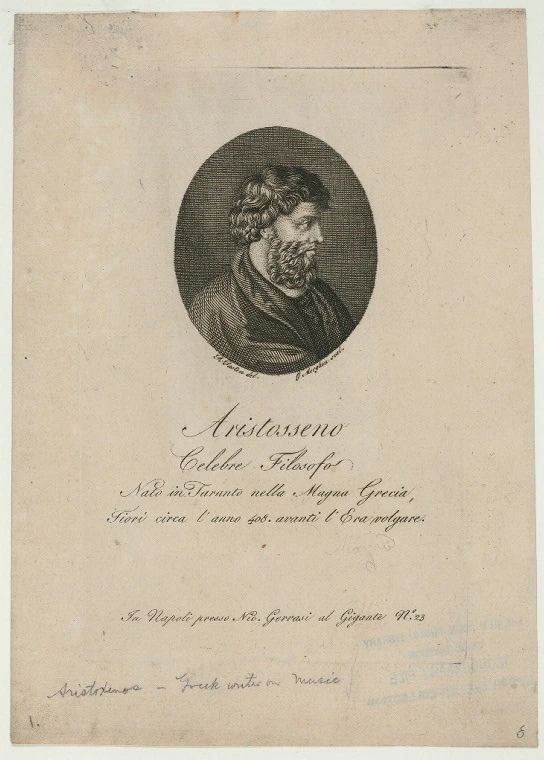
Aristoxenus of Tarentum, Aristóxenos *ca. 354 BC, Tarentum, †300 BC Athens, Greek philosopher and music theorist. He was initially educated by his father, Spintharus, a student of Socrates. He continued his musical studies under Lamprus of Erythrae. For a time, he lived in Mantinea, and after 343 in Corinth, where he made contact with Dionysius the Younger, the tyrant of Syracuse, who was in exile there. He then went to Athens, where he studied first under the Pythagorean Xenophilus and later under Aristotle. He was one of Aristotle’s closest students and was to become his successor at the Peripatetic school, Lykeion [Lyceum]. Ultimately, Theophrastus became Aristotle’s successor.
According to data from the Byzantine lexicon, the so-called Suda, Aristoxenus was the author of 453 philosophical, historical, and musical works; this number is probably exaggerated. Fragments of his works on music theory have survived, either in later editions or as quotations by other authors; most of Aristoxenus’ musical treatises are known only by their titles. The three preserved books on harmony, known as Harmoniká stoicheia (‘elements of harmonics’ [known as The Harmonics of Aristoxenus]), most likely come from two different treatises by Aristoxenus: the first book from Archaí (‘principles’), the other two from Stoicheía (‘elements’). Parts of the second book of the extensive work Rhythmiká stoicheia (‘elements of rhythm’) have survived. Fragments from the work Sýmmikta sympotika (‘dinner conversations’) were passed down by Plutarch in his treatise Perí musikēs (‘on music’). Cleonides (2nd century BC) based his treatise Eisagōgē harmonikē (‘introduction to harmonics’) on an unknown work by Aristoxenus on harmonics. Extensive excerpts from Aristoxenus’ works have also been preserved in an anonymous Greek treatise published by F. Bellermann (Anonymi scriptio de musica…, 1841). Aristoxenus’ comments on musical instruments were passed on by Athenaeus in Deipnosophistaí (‘the dinner Sophists’). In addition, the following titles of Aristoxenus’ works are known: Dóxai harmonikōn (‘principles of harmonics’) – probably a polemical treatise, Perí musikēs (‘on music’), Peri melopoías (‘on composing melodies’), Perí tónōn (‘on tones’), Perí musikēs akroáseōs (‘on listening to music’), Historiká tēs musikēs (‘history of music’), Perí aulōn trēseōs (‘on the drilling of [aulos] pipes’), Perí aulētōn (‘on flute players’), Perí aulōn kai orgánōn (‘on aulos pipes and organs’), Perí tragōdopoiōn (‘on the creators of tragedies’), Perí tragikēs orchēseōs (‘on dance in tragedy’). Remarks on music can also be found in Aristoxenus’ works on other subjects, including the fragmentarily preserved Bíoi andrōn (‘lives of men’).
Ancient writers, including Cicero, recognized Aristoxenus as an outstanding authority in the field of music. He is now considered to be the first Greek theorist to have systematized the music theory of his time. Aristoxenus’ achievements include the classification of musicology, in which he distinguished two branches: practical (téchnai praktikaí) and theoretical (téchnai theoreticaí). He included instrumental music, poetics, and dance in the first branch, and harmony, rhythmics, and metre in the second; this division was adopted by Plutarch. Aristoxenus contrasted téchnai praktikaí with the creative arts, which included architecture, sculpture, and painting. In his research on music, he used an empirical method, which reflects the influence of Aristotle and the Peripatetic school. He relied primarily on auditory experience. He claimed that the most important thing for a musician is the accuracy of sensory perception, and that knowledge of music is based on two elements: perception and memory, thanks to which hearing has an active character; the listener can compare tones that have already faded away with those that are still sounding.
Basing his acoustic research on auditory perception meant that Aristoxenus did not attach importance to the acoustic purity of intervals, i.e. to those differences in pitch that can be calculated but cannot be heard. The position of Aristoxenus, who studied qualitative differences between sounds, was opposed to the views of the Pythagoreans, who focused on quantitative differences. Aristoxenus’ achievements include the division of the octave into 6 whole tones and the division of the fourth into 2 whole tones and a semitone. Aristoxenus accused the Pythagoreans of overestimate the importance of mathematical calculations in their studies of music. However, he agreed with the Pythagorean theory of ethos. Although he appreciated the aesthetic qualities of music, he attached the greatest importance to its ethical properties. Similarly to the Pythagoreans, he was critical of contemporary composers of kitharoedic nomoi [also citharodic nomos] and dithyrambs – Phrynis of Mytilene, Melanippides the Younger of Melos [now Milos], Cinesias of Athens, Philoxenus of Cythera, Krexos [also Crexos], and especially Timotheus of Miletus – perceiving a lack of ethical impulse in their music. He opposed the overuse of chromatic and enharmonic genera in music. He recognized only the diatonic genus coloured chromatically or enharmonically; he was opposed to pure chromaticism and enharmonics. He presented this position in his teachings on chróai (colour). He accepted only one type of enharmonic division of the fourth – a progression containing an interval corresponding approximately to a major third and two quarter tones. In the diatonic genus, he allowed two types of “coloration,” and three in the chromatic genus.
One of Aristoxenus’ greatest achievements was the introduction of the concept of absolute pitch (mégethos) and the concepts of thésis and dýnamis, which define the position of a note within the two-octave sýstēma téleion (thésis) and within the transposed scale (dýnamis). The theory of thésis and dýnamis was adopted and developed by Claudius Ptolemy (2nd century AD). Aristoxenus also established the nomenclature and system of transposed scales. Aristides Quintilianus (Perí musikēs) states that Aristoxenus distinguished the following 13 scales (tonoi): 1. Hypodorian, 2. Low Hypophrygian (barýs) = Hypoiastian, 3. High Hypophrygian (oxýs), 4. Low Hypolydian (barýs) = Hypoaeolian, 5. High Hypolydian (oxýs), 6. Dorian, 7. Low Phrygian (barýs) = Lastian, 8. High Phrygian (oxýs), 9. Low Lydian (barýs) = Aeolian, 10. High Lydian (oxýs), 11. Low Mixolydian (barýs) = Hyperdorian, 12. High Mixolydian (oxýs) = Hyperiastian, 13. Hypermixolydian = Hyperphrygian.
Aristoxenus’ achievements also include the systematization of the theory of rhythm. He took as his starting point the division of the metrical foot into a strong beat (ársis) and a weak beat (básis [also called thésis]). Depending on the temporal relationship between ársis and básis, he distinguished three types of rhythm standing in ratios of 2:2, 1:2, and 3:2 or 2:3, defining them in relation to the metrical foot as dactylic (ـَᴗᴗ), iambic (ᴗـَ), and paeonic (ـَᴗـَ) rhythms, respectively. These three basic patterns can be multiplied: the three-beat iambic rhythm can be repeated 2, 3, 4, 5, and 6 times, reaching up to 18 time units; the four-beat dactylic rhythm can be repeated up to 4 times, reaching up to 16 time units; the five-beat paeonic rhythm can be repeated at most 5 times and can contain at most 25 time units. In addition, Aristoxenus distinguished 3 types of compound rhythmical feet (pús synthétēs): double (dimerḗs), triple (trimerḗs) and quadruple (tetramerḗs), with the first two types referring to trochaic (ـَᴗ), dactylic and iambic meters, and the third type referring only to trochaic and dactylic meters. Of the double feet, the trochaic contains 6, the dactylic 8, and the iambic 12 time units; of the triple feet, the trochaic contains 9, the dactylic 12 time units, etc.
Aristoxenus’ comments on musical instruments are known only from the writings of Athenaeus of Naucratis. Aristoxenus described a number of instruments as non-Greek, namely: phoinix (Phoenician lyre), pēktis, mágadis, sambýkē, trigōnon, enneáchordon, klepsiambos, and skindapsós. He also distinguished instruments belonging to the aulos family: auloi parthénioi, kitharistērioi, paidikoi, téleioi, and hypertéleioi.
Literature: A. Rossbach, R. Westphal Metrik der griechischen Dramatiker und Lyriker, 2 vols., Leipzig 1854–56; R. Westphal Harmonik und Melopöie der Griechen, Leipzig 1863; R. Westphal Allgemeine griechische Metrik, Leipzig 1865; P. Marquard De Aristoxeni Tarentini elementis harmonicis, Bonn 1863; K. v. Jan Die griechische Musik, I: Die Harmonik des Aristoxenos, “Philologus” XXIX, 1870; R. Westphal Griechische Rhythmik, Leipzig 1885; R. Westphal Die Aristoxenische Rhythmuslehre, “Vierteljahrschrift für Musikwissenschaft” VII, 1891; H. Abert Die Lehre vom Ethos in der griechischen Musik, Leipzig 1899; H. Riemann Handbuch der Musikgeschichte, vol. 1, Leipzig 1904; C.F. Abdy Williams The Aristoxenian Theory of Musical Rhythm, Cambridge 1911; G. Urbain Le tombeau d’Aristoxène, essai sur la musique, Paris 1924; L. Kallenbach-Greller Die historischen Grundlagen der Vierteltöne, “Archiv für Musikwissenschaft” VIII, 1926; J. Handschin Der Toncharakter, Zurich 1948; N. Cazden Pythagoras and Aristoxeons reconciled, “Journal of the American Musicological Society” XI, 1958; L. Richter Die Aufgaben der Musiklehre nach Aristoxenos und Kl. Ptolemaios, “Archiv für Musikwissenschaft” XV, 1958; W. Tatarkiewicz Historia estetyki, vol. 1: Estetyka starożytna, Wrocław 1960; W. Vetter Skizzen zur griechischen Musik, 1927–57, in: Mythos-Melos-Musica. Ausgewählte Aufsätze zur Musikgeschichte, vol. 1, Leipzig 1961; H. Potiron La notation grecque au temps d’Aristoxene, “Revue de Musicologie” L, 1964; R.L. Crocker Aristoxenus and Greek Mathematics, in: Aspects of Medieval and Renaissance Musie, commemorative book of G. Reese, New York 1966; H. Becker Syrinx bei Aristoxenos, in: Musa-Mens-Musici, commemorative book of W. Vetter, Leipzig 1970; A.D. Barker Music and Perception. A Study in Aristoxenus, “Journal of Hellenic Studies” XCVIII, 1978 and Hoi kaloumenoi harmonikoi. The Predecessors of Aristoxenus, «Proceedings of the Cambridge Philological Society» XXIV, 1978; A. Bélis Les nuances dans le Traité d’harmonique d’Aristoxène de Tarente, “Revue des études grecques” XCV, 1982; A.D. Barker Aristoxenus Theorems and the Foundations of Harmonic Science, «Ancient Philosophy» IV, 1984; A. Branacci Aristosseno e lo statuto epistemologico della scienza armonica, in: La scienza ellenistica, eds. G. Giannantoni, M. Vegetti, Neapol 1984; A. Barbera Reconstructing lost Byzantine Sources for MSS Vat. BAV gr. 2338 and Ven. BNM gr. VI.3. What is an Ancient Music Treatise?, in: Music Theory and Its Sources. Antiquity and Middle Ages, ed. A. Barbera, Notre Dame Conferences in Medieval Studies 1, Paris 1990; A.M. Laskowska Koncepcja harmoniki Arystoksenosa z Tarentu, “Archiwum Historii Filozofii i Myśli Społecznej” 64, 2019; J. Landels Muzyka starożytnej Grecji i Rzymu, Krakow 2002; M.L. West Muzyka starożytnej Grecji, Krakow 2003.
Aristoxeni Harmonicorum elementorum libri III…, in Latin, ed. A. Gogavino, Venice 1562
Aristoxenus, Nicomachus, Alypius. Auctores musices antiquissimi…, in Latin, ed. J. Meursius, Leiden 1616
Aristoxeni Harmonicorum elementorum libri III…, in: Antiquae musicae auctores septem, in Greek and Latin, ed. M. Meibomius, vol 1, Amsterdam 1652
Aristoxenos’ Grundzüge der Rhythmic…, in Greek and Lati, ed. H. Feussner, Hanau 1840
Anonymi scriptio de musica, ed. F. Bellermann, Berlin 1841
Aristoxeni Elementorum rhythmicorum fragmentum, with explanatory notes, ed. J. Bartels, Bonn 1854
Aristoxenou Harmonikon ta sozomena. Die harmonischen Fragmente des Aristoxenus. Anhang, die rhythmischen Fragmente…, in Greek and Latin, ed. P. Marquard, Berlin 1868
Éléments harmoniques d’Aristoxene…, French translation, Ch.-E. Ruelle, Paris 1870
Aristoxenus von Tarent. Melik und Rhythmik des klassischen Hellenentums, vol. 1 in German with commentary ed. R. Westphal, Leipzig 1883, vol. 2, original text, ed. F. Saran, Leipzig 1893, reprint in 2 vols., Hildesheim 1965
Aristoxène de Tarente: le Traité d’harmonique, in Greek and French, ed. A. Bélis, Paris 1986
Aristoxénou Harmoniká stoicheía. The Harmonics of Aristoxenus, in Greek and English, with an introduction and footnotes, ed. H.S. Macran, Oxford 1902
Aristosseno Elementa Harmonica, lib. I-III, Elementa rhythmica, lib. II, English translation A. Barker, in: Greek Musical Writings, vol. 2: Harmonic and Acoustic Theory, ed. A. Barker, «Cambridge Readings in the Literature of Music», Cambridge 1989
Elementa rhythmica. The Fragment of Book II and the Additional Evidence for Aristoxenian Rhythmic Theory, ed. L. Prearson, Oxford 1990
Arystoksenos z Tarentu, Harmonika, Polish translation, introduction and commentary by Anna Maciejewska, Łódź 2015
Arystoksenos z Tarentu, Elementy rytmu, Polish translation A.M. Laskowska, „Archiwum Historii Filozofii i Myśli Społecznej” 61, 2016