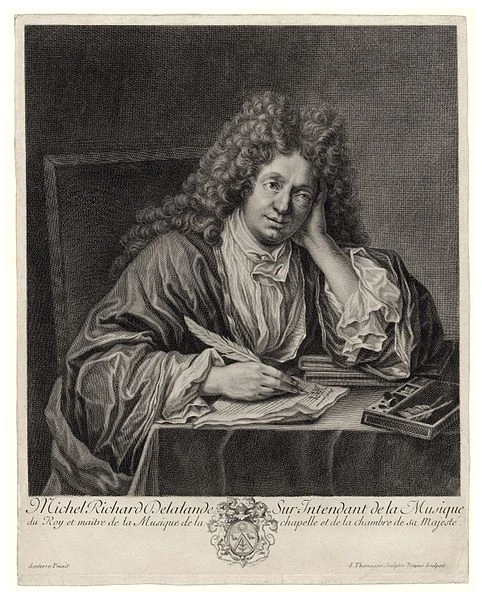
Delalande, La Lande de, Lalande de, Michel-Richard, *15 December 1657 Paris, †18 June 1726 Versailles, French composer and organist. From around 1666 to 1672, he was a chorister at the Church of St-Germain l’Auxerrois in Paris, where he probably also learned to play the organ, harpsichord and violin, although unfortunately it is not known who taught him. After his voice changed, he applied for a position as a violinist at the Paris Opera. When he was unsuccessful, he turned to the organ and harpsichord, serving as organist at the Parisian churches of St-Louis and Petit St-Antoine, later at St-Gervais from 1679, and at St-Jean-en-Grève from 1682. He was one of the first to discover F. Couperin’s talent for composition. In 1683, Delalande won a competition to become one of four sous-maîtres de la musique in the royal chapel (each of these musicians performed their duties for one quarter of the year). However, Delalande eventually eliminated the other sous-maîtres and from 1714 was the sole director of the chapel. He also held almost all the important musical positions at the royal court: compositeur de la musique de la chapelle, surintendant de la musique de la chambre and compositeur de la musique de la chambre. In 1722, following the death of his wife, the singer Anne Rebel, Delalande resigned from each of his prestigious positions in turn. He remarried in 1723. In 1729, after his death, a luxurious edition of Delalande’s motets was published at the king’s expense.
Delalande was one of the most outstanding French composers from the time of Louis XIV. His ballets and divertissements are similar in form to the French opéra-ballet or the Italian cantata. However, Delalande’s most important works are his grand motets, over 70 compositions of confirmed authenticity, written for the royal chapel, but also performed as part of the Concerts spirituels series in Paris. They were considered masterpieces of the genre throughout the 18th century. Two stylistic trends can be observed in this repertoire. His earliest compositions are characterised by syllabic treatment of the text, simplicity, recitatives written for soprano with accompaniment by a five-part string orchestra, homophonic choruses, and a loose overall structure. In his later motets, the influence of Italian music can be observed, manifested in the structured form of the motets, divided into more elaborate, concertante airs with obbligato instrumental accompaniment, duets, and choruses with polyphonic texture. Whereas in Delalande’s early motets the orchestra essentially doubled the choral voices, it later gained greater independence. Throughout his life, Delalande changed, reworked and improved his earlier works according to his own ideas. Building on the achievements of his predecessors (Th. Gobert, H. Dumont and J.B. Lully), Delalande created a model for the motet that was later imitated by other composers. Between 1682 and 1704, Delalande also composed secular and stage music such as ballets, divertissements and pastorales. He collaborated with Destouches on Ballet des Eléments, which, as an opéra-ballet, was a great success at the Paris Opera following its premiere in 1725. He also composed instrumental music, suites referred to as symphonies and caprices. One of his most famous instrumental compositions is Grande pièce en G-ré-sol.
Literature: A. Tessier La carrière versaillaise de La Lande, “Revue de Musicologie” August 1928; A. Cellier Les motets de Michel-Richard de La Lande, “La Revue Musicale” February/ March 1946; Notes et références pour servir à une histoire de Michel-Richard Delalande…, ed. N. Dufourcq et al., Paris 1957 (includes a thematic catalogue); N. Dufourcq Michel-Richard Delalande, “Revue de Musicologie” XXXV, 1953; J.E. Richards Structural Principles in the Grands Motets of Michel-Richard de Lalande, “Journal of the American Musicological Society” XI, 1958; G. Thibault Le “Te Deum” de Lalande, “Fontes Artis Musicae” XII, 1965; J.R. Anthony French Baroque Music from Beaujoyeulx to Rameau, London 1973, 21978; B. Coeyman The Stage Works of Michel-Richard Delalande in the Musical-Culture Context of the French Court, 1680–1726, New York 1987; M. Barthélemy Les oeuvres de Racine pour Saint-Cyr et le contexte musical contemporain, Brussels 1992; L.H. Sawkins The Sacred Music of Michel-Richard de Lalande (1657–1726), London 1993; L. Sawkins …à l’admiration de tout Paris: Lalande’s Sacred Music for Women’s Voices, in: Essays in Honour of David Evatt Tunley, ed. F. Callaway, Perth 1995; C. Massip Michel-Richard Delalande ou le Lully latin, Geneva 2005.
Compositions:
Instrumental:
Symphonies pour les Soupers du Roy (12 suites, some from ballets and divertimenti), 3 MS (1703, 1727, 1745) Paris, Bibliothèque Nationale
Symphonies des Noëls, MS 1727 and 1745
Airs de violons de L’inconnu, Paris 1720
Vocal-instrumental:
around 71 grands motets for soloists, choir, orchestra and organ, including 40 published in the collection Motets de feu De La Lande…, Paris 1729–33
Miserere
3 Leçons de ténèbres for solo voice
Messe de deffuns
Magnificat, text by Racine
Te Deum, text by Racine
Cantique spirituel, text by Racine
psalms, hymns, and antiphons preserved in manuscripts
Stage:
20 stage works (ballets and divertissements), including: Les fontaines de Versailles, performed in Versailles 1683
Le ballet de la Jeunesse, performed in Versailles 1686
Le palais de Flore, performed in Trianon 1689
Adonis, divertissement, performed in Fontainebleau 1696
Comédie des Fées, performed in Fontainebleau 1699
L’hymen champestre, private performance 1700
intermedia for the comedy Mirtil et Mélicerte, text by Molière and Guérin, performed in Fontainebleau 1698
Le noce de village, performed in Sceaux 1700
Le ballet de la Paix, divertissement, private performance 1713
L’inconnu, text by Th. Corneille, performed and published in Paris 1720
Les folies de Cardenio, performed in Paris 1720
Les éléments, with A.C. Destouches, opera-ballet, performed in Paris 1725
Editions:
Les éléments, after the 1725 edition, piano reduction V. d’Indy, in: «Chefs-d’oeuvre de l’opéra français», Paris 1883
Symphonies des Noëls, Nos. 1–4, ed. A. Cellier, Paris 1937
Symphonies des Noëls, Nos. 1–4, Eibelstadt 2017
numerous motets ed. L. Boulay, A. Cellier, D. Chirat, F. Raugel, G. Roussel, H.L. Sarlit and M. Gennaro, mostly in the series «Les chefs-d’oeuvre religieux de l’école classique de Versailles»