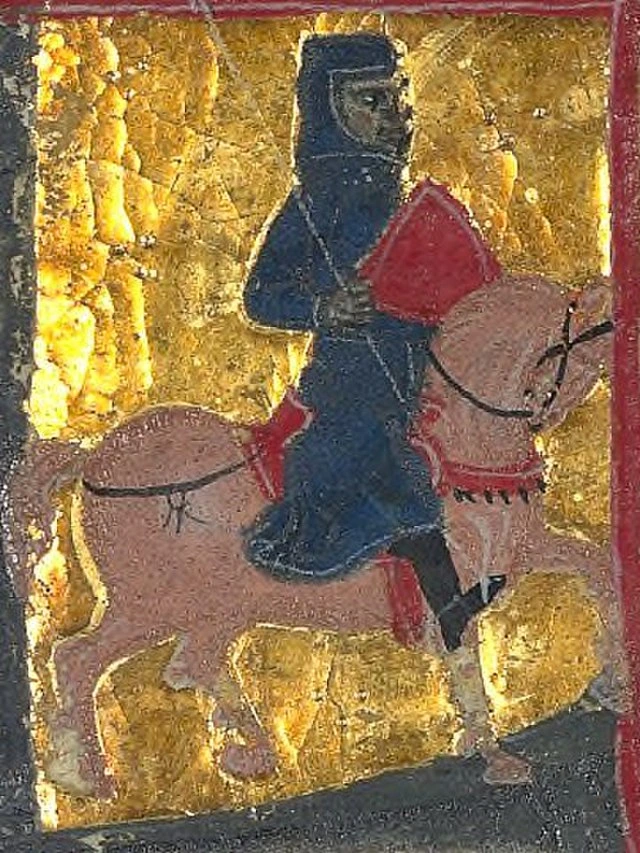
Bertran de Born, *ca. 1140 Born castle (western Aquitaine), †before 1215 Abbey of Dalon (near Périgueux, western Aquitaine), Provençal troubadour, castellan of the diocese of Périgord, viscount of Hautefort (Altafort). Little is known about his life; numerous razos, i.e. commentaries on his works, describe Bertran de Born’s passion for military adventures. He took direct part in numerous conflicts between feudal lords, including the Plantagenets’ disputes over the rights to Aquitaine and Richard the Lionheart’s battles with Philip Augustus, the King of France. At the end of his turbulent life, he entered the Cistercian monastery in Dalon (1195). Bertran de Born occupies a special place in the history of medieval songs due to his almost complete abandonment of the conventional theme of courtly love and his focus on military themes. Dante (De vulgari eloquentia), distinguished among three theme types of lyric poetry – love, virtue, and war – and mentioned him as the only representative of the latter group. A total of 45 works by Bertran de Born have survived, including the song Rassa, tan creis e mont’e poia with melody (Paris, Bibliothèque Nationale, fr. 22543). In most of his poems, mainly belonging to the sirventes genre, he vividly depicted the characteristics of an exemplary knight, but most often he addressed issues related to current political events.
Editions, Literature: A. Thomas Poésies complètes de Bertran de Born, Toulouse 1888; T. Stroński La légende amoureuse de Bertran de Born, Paris 1914; C. Appel, Die Lieder Bertrans von Born, Halle 1932; Der musikalische Nachlass der Troubadours, ed. F. Gennrich, 3 vols., Darmstadt 1958–65; Y. Boutière, A.-H. Schutz Biographies des troubadours, Paris 1950, revised ed. with I.-M. Cluzel, Paris 1964; J. Maillard Anthologie de chants de troubadours, Nice 1967; P. Harris Stäblein Love poems with political hearts. Bertran de Born and the courtly language of war, in: Studia Occitanica, commemorative book of P. Remy, vol. 1: The Troubadours, ed. H-E. Keller, J-M.D. Heur and others, Kalamazoo 1986.